
We get asked about knives more than almost anything else in the shop. And honestly? We love it. A great knife is one of those rare things that genuinely changes how you cook — and once you've used a properly sharp, well-balanced blade, there's no going back.
But the world of kitchen knives can feel a bit overwhelming. Japanese or European? Stainless or carbon steel? Do you really need a block? We're here to cut through the confusion (pun very much intended) and help you find exactly what you need.
Start Here: The One Knife That Changes Everything
Before we get into the details, here's the most important thing we can tell you: you don't need many knives — you need the right ones. Most home cooks, even very enthusiastic ones, can get along beautifully with just two or three.
If you're starting from scratch or upgrading for the first time, begin with a good chef's knife. It's the workhorse of the kitchen — slicing, dicing, chopping, mincing. An 18–20cm (7–8 inch) blade suits most people perfectly.
Spend the majority of your budget on one excellent chef's knife rather than spreading it across a whole block of mediocre ones. A single great knife will serve you far better than six average ones gathering dust.
Japanese vs European — What's the Difference?
This is the question we get most often, so let's settle it simply.
Harder steel, usually a thinner edge, and exceptional sharpness. Best for precise, delicate work — slicing fish, thin vegetable cuts, fine prep. Requires a little more care.
Slightly softer steel, broader bolster, sometime a finger guard style, more curved belly for rocking motion. Tough, forgiving, and brilliant for everyday use. Great if you're not precious about maintenance.
Neither is better — they're just different. If you love precision and care for your tools, Japanese knives are deeply satisfying. If you want something you can rely on every day without overthinking it, a European-style knife like a Sabatier or Robert Welch is a joy.
We also love the idea of having one of each — a Japanese blade for finesse work, and a German one for the rough and tumble of everyday cooking. It's a combination that covers everything.
The Knives Worth Knowing
The Chef's Knife (18–20cm)
Your most-used blade, full stop. It handles about 90% of kitchen prep with ease. Brands like Global, Kai, Lion Sabatier and Robert Welch all make outstanding chef's knives at different price points — we're happy to walk you through the differences in-store.

The Paring Knife (8–10cm)
The little knife you'll reach for constantly. Peeling, trimming, scoring, hulling strawberries — it's nimble, precise, and a real pleasure to use. If you're buying a second knife, make it this one.

The Bread Knife (20–25cm)
Often overlooked, genuinely essential. A good serrated bread knife glides through a sourdough crust without squashing it — and it's also brilliant for slicing tomatoes, cakes, and anything with a soft interior and firmer exterior.

The Santoku (16–18cm)
A Japanese all-rounder that's become a favourite for many home cooks. Is this East meets West? The Santoku (three virtues) is shorter and lighter than a traditional chef's knife, with a flatter cutting edge — great for chopping, slicing and dicing (three virtues again) in a more up-and-down motion. If a full chef's knife feels a bit big in your hand, try a Santoku.

"The right knife doesn't just make prep faster — it makes cooking more enjoyable. That matters."
— The Simmer & Slice teamSteel Types: What You Actually Need to Know
| Type | Pros | Things to Know |
|---|---|---|
| Stainless Steel | Low maintenance, rust-resistant, dishwasher-tolerant (though we'd still recommend hand washing) | Won't hold an edge quite as long as harder steels |
| High-Carbon Stainless | Best of both worlds — holds an edge well and resists rust. Most premium knives use this. | Rinse and dry after use to keep it in top condition |
| Carbon Steel | Incredibly sharp, easy to resharpen, develops a patina over time | Needs more care — dry immediately, oil occasionally. Loves being used. |
For most home cooks, high-carbon stainless is the sweet spot. You get excellent performance without too much fuss. Carbon steel is a lovely choice if you enjoy the ritual of caring for your tools — there's something genuinely satisfying about a well-maintained carbon steel blade.
Handles: Comfort Matters More Than You Think
A knife that doesn't feel right in your hand is a knife you won't enjoy using. Here's what to look for:
Balance — hold the knife at its balance point (usually just in front of the bolster). It should feel natural, not tip-heavy in either direction.
Handle material — resin, wood, and composite handles all have their fans. Wood is beautiful but needs a little care. Composite handles like those on Robert Welch knives are hygienic and wonderfully grippy.
Your grip style — if you use a pinch grip (thumb and forefinger pinching the blade, not the handle), you'll want a knife with a comfortable bolster. If you hold the handle fully, look for a shape that fills your hand well.
We always encourage customers to handle knives before committing. Pop into our store at Trentham Gardens and we'll happily let you hold a few — it makes such a difference. Our team knows every knife we stock and will find the right match for you.
Looking After Your Knives
A quality knife, well looked after, should last a lifetime. Here's how to treat yours well:
Never the dishwasher. Heat and detergent degrade handles and dull edges faster than almost anything else. A quick wash by hand and a dry with a cloth is all they need.
Use a wooden or plastic cutting board. Glass, ceramic, and metal boards are brutal on knife edges. A good wooden board protects your blade and looks beautiful on a worktop.
Hone regularly, sharpen occasionally. A honing steel (or ceramic rod) realigns the edge between sharpenings — use it before or after each session. Sharpening (removing metal to create a new edge) should only be needed a few times a year for home cooks. For the ultimate sharpening tool, we offer the Horl3. If you want to sharpen those knives and protect your investment, then we find this sharpener to be one of the best on the market. We offer in-store demos of this as well!
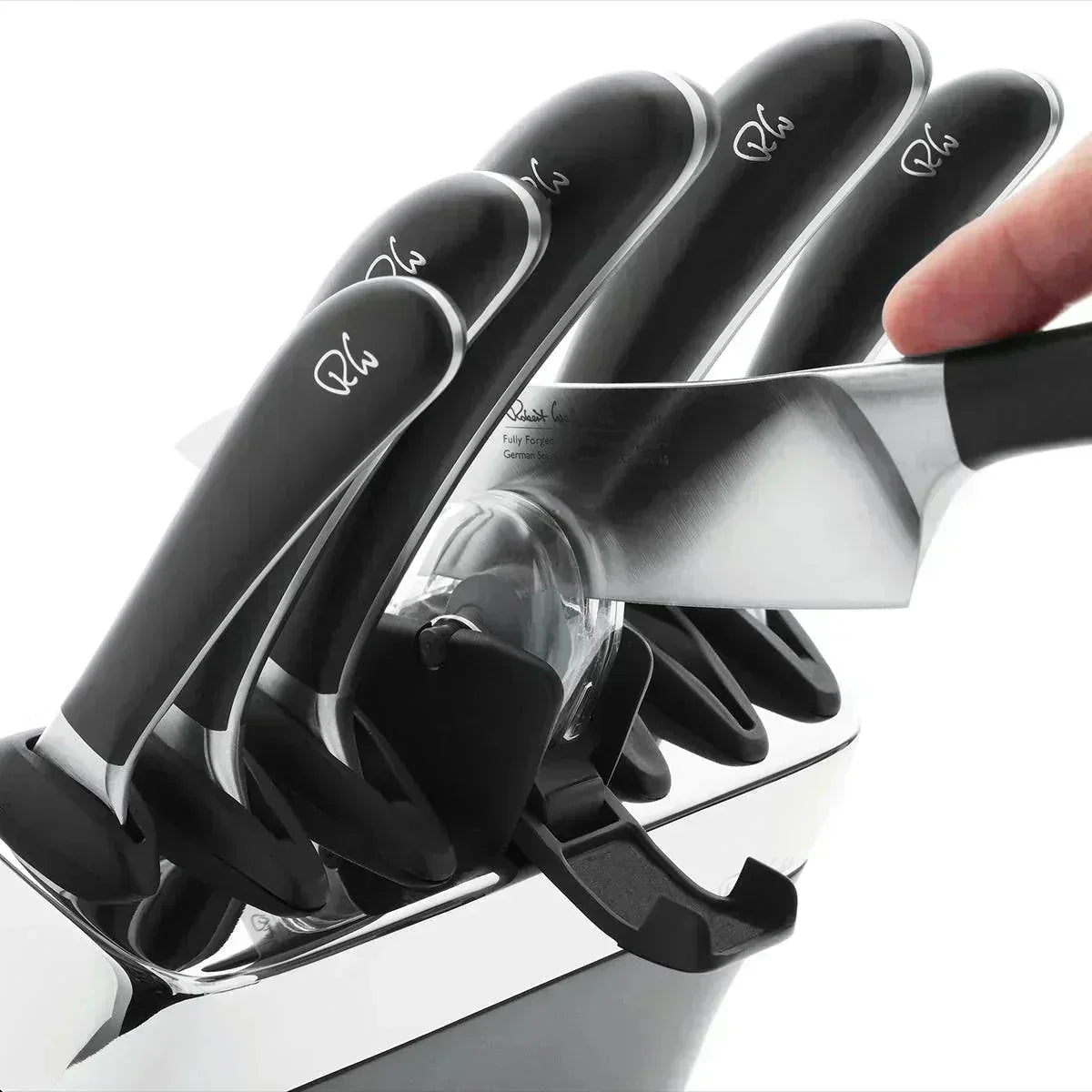
Store them properly. A magnetic knife strip or a wooden knife block both work brilliantly. Loose in a drawer? That's how edges get damaged — and fingers too. Blade guards are available - online and instore.
Our Favourite Brands — and Why We Stock Them
Every brand we carry at Simmer & Slice has been chosen because we genuinely believe in it. Here are a few standouts in the knife world:
Global — Japanese precision engineering with an iconic dimpled handle. Beautifully balanced, exceptionally sharp, and they hold their edge superbly. A genuine heirloom knife. Special orders are available for the full collection.
Kai — another Japanese maker with a wonderful range that spans accessible everyday knives right through to professional-grade Damascus blades. Something for every level. Special orders are available for the full collection.
Lion Sabatier — a storied French name synonymous with quality chef's knives. The bolster and balance are classic, the steel is excellent, and there's something deeply satisfying about their weight in the hand. Avoid the licensed ranges of Sabatier unless it is just for a promotional purpose. The two are very different. Special orders are available for the full collection.
Robert Welch — a British design classic. Their Signature range is a favourite in our shop — elegant, well-made, and works with pride from a UK heritage brand. We also offer the Professional Range in-store and online. Special orders are available for the full collection.
So — Where Do You Start?
If we had to give you one piece of parting advice, it's this: buy less, buy better. One knife that genuinely excites you, that feels right in your hand, that you sharpen and look after — that knife will make every meal more enjoyable.
Come and see us at Trentham Gardens. We'll make you a cup of tea, let you handle a few options, and find the knife that's right for you. That's what we're here for.
Ready to Find Your Perfect Knife?
Visit us in-store at Trentham Gardens or browse our full knife collection online. Free UK delivery on orders over £40.
Shop Knives at Simmer & Slice →